
image post2yr at archive captureWritten by Puviin Varman
Difference between RECs and Carbon Credits
A practical comparison of Renewable Energy Certificates and carbon credits, their units, claims, and policy purposes.
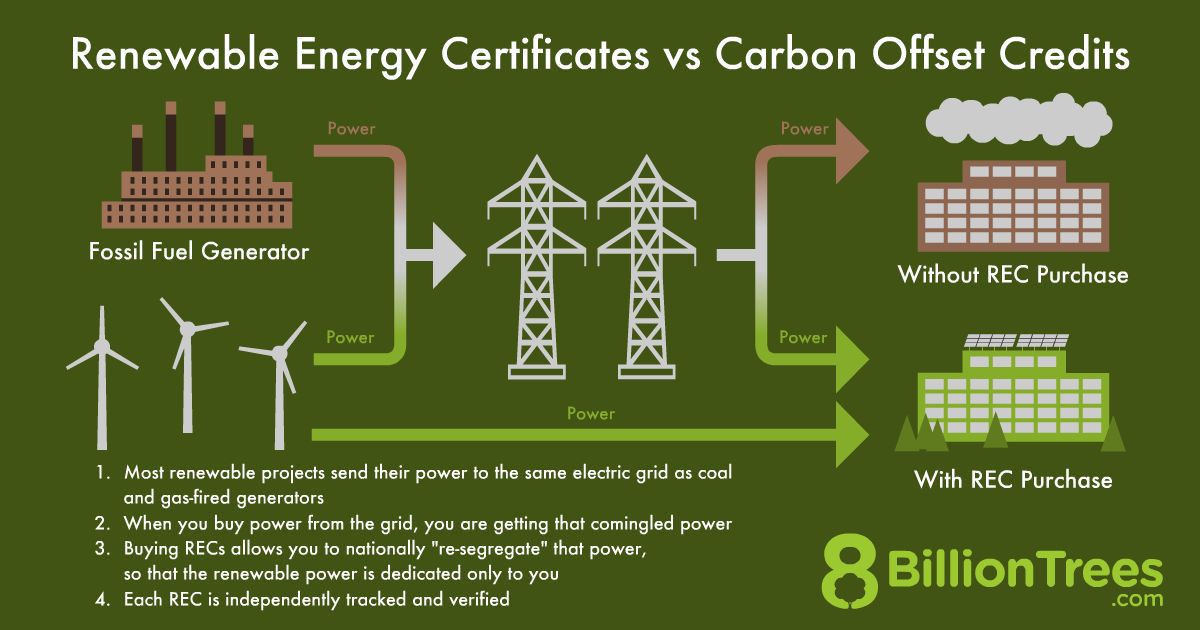
The first retained graphic visibly credits 8BillionTrees.com. The source of the second emissions-trading graphic was not identified in the supplied archive. Both are preserved as they appeared with the LinkedIn post and are not presented as original illustrations by Puviin.
Original LinkedIn post text
[Difference between RECs and Carbon Credits]
Over the past 6 months I was fortunate enough to get the oppurtunity to work with Rene Velasquez, one of the top minds within the Carbon Markets, on the CARBON EXPOSURE. Throughout the process of listening to his various interviews with the very best minds of the Carbon Markets, I picked up quite a few lessons about the various tools created in place within markets to fight climate change.
I'd like to share what I've learnt to help people understand this nacent but crucial market. I'd like to share two important financial tools used/traded actively within this sector that I've been questioned quite a bit about, ie Renewable Energy Certificates(RECs) and Carbon Credits.
Starting off with:-
A) Carbon Credits
1. Purpose: Carbon Credits, or Carbon Offsets , are aimed at reducing overall carbon dioxide (CO2) and other greenhouse gas emissions in the atmosphere. They are part of carbon trading schemes.
2. How they work: One carbon credit typically represents the right to emit one ton of CO2 or an equivalent amount of other greenhouse gases. Companies, governments (in some countries) or other entities that produce emissions can buy carbon credits to offset their own greenhouse gas emissions. Therefore, 1 ton emitted - 1 carbon credit = 0.
3. Aim: The idea is to cap total carbon emissions and reduce them over time (therefore the term "cap and trade" is used). Entities that reduce their emissions can sell their excess credits to those who are over their emission limits. This system incentivizes reducing emissions, as companies can financially benefit from being under their cap and selling them on carbon markets.
B) Renewable Energy Certificates (RECs):
1. Purpose: RECs are designed to PROMOTE renewable energy production. Each REC represents proof that 1 megawatt-hour (MWh) of electricity was generated from a renewable energy source, like wind, solar power or even hydro power.
2. How do RECs work?: When renewable energy is produced and fed into the electrical grid, an equivalent number of RECs is created. Energy consumers (i.e companies etc) can purchase these certificates in addition to their regular energy supply to claim that they are using renewable energy, this is particularly advantageous to organisations looking to meet regualtions without investing a high amount in intial capex (installing solar panels etc).
3. Aim: RECs incentivize the production of renewable energy. By purchasing RECs, consumers indirectly support renewable energy projects, contributing to the growth of green energy production.
Key Differences:
1. RECs are focused specifically about renewable energy production, while carbon credits are about reducing greenhouse gas emissions.
2. RECs are a one-to-one certificate for renewable energy production, whereas carbon credits are part of a cap-and-trade system for emissions.
Stay tuned I'll be sharing more about my learnings within the Carbon Markets.
#carbonmarkets